3D Vision
Spatial intelligence for the physical world—reconstruction, understanding, generation, and embodied interaction.
Overview
3D Vision is a foundational direction for building AI systems that understand, reconstruct, generate, and interact with the physical world. While 2D vision focuses on images and videos as visual observations, 3D vision asks a deeper question: how can machines recover the structure of the world behind visual signals, reason about space and geometry, and use that understanding to support perception, creation, simulation, and action? This makes 3D Vision a strategic research area that connects computer vision, graphics, robotics, embodied AI, augmented reality, digital twins, and world modeling.
The importance of 3D Vision comes from the fact that intelligence in the real world is inherently spatial. Humans do not only recognize objects. We understand where things are, how they are shaped, how they relate to each other, how they can be manipulated, and how scenes change when we move through them. Future AI systems will need similar spatial competence. They must build persistent representations of environments, reason across viewpoints, infer hidden structure from partial observations, understand object geometry and scene layout, and support interaction in both physical and virtual spaces. In this sense, 3D Vision provides the geometric foundation for visual intelligence.
Our vision is to develop 3D visual systems that move beyond passive reconstruction toward spatial understanding, generative modeling, and embodied interaction. A strong 3D system should not only reconstruct what is visible, but also infer what is occluded, align perception across time and viewpoints, understand semantic and functional relationships, and represent the world in a way that can support reasoning and action. This requires models that combine geometry, appearance, semantics, dynamics, and physical structure in a unified spatial representation. At a strategic level, our work connects reconstruction and representation, scene understanding over time, controllable 3D creation, and embodied world models into one research program.
Reconstruction and spatial representation
The first goal of 3D Vision is to recover the structure of scenes, objects, and environments from visual observations. This includes reasoning about geometry, depth, surfaces, volumes, camera motion, and multi-view consistency. More broadly, it asks how visual systems should represent the world so that the representation is accurate, efficient, editable, and useful for downstream reasoning. We study implicit surfaces, point clouds, meshes, neural fields, and Gaussian splatting as complementary scene representations, with emphasis on scalability, photorealism, and interfaces that support editing, querying, and fusion across views and modalities.
Scene understanding and dynamic 3D perception
Geometry alone is not enough. AI systems must understand what objects are present, how they are arranged, which parts belong together, what functions they serve, and how they interact with people and other objects. 3D scene understanding connects spatial structure with semantics, affordances, physical constraints, and task-level reasoning. The real world is not static: objects move, people act, cameras change viewpoint, and environments evolve over time. A central challenge is to build 3D systems that model dynamic scenes, maintain temporal consistency, track changes, and reason about motion and interaction in space—linking reconstruction with recognition, grounding, and long-horizon spatial memory.
Generation, embodiment, and world modeling
3D content is becoming a core medium for design, simulation, games, virtual production, augmented reality, and digital environments. Future systems should generate and edit 3D assets, objects, scenes, and worlds with controllable geometry, appearance, semantics, and physical plausibility. 3D Vision is equally essential for agents that act in the world: robots, embodied assistants, and interactive systems need spatial maps, object-level understanding, navigation, manipulation awareness, and prediction of how actions change the environment. Long-term world models must capture not only appearance, but structure, evolution, and interaction—supporting simulation, planning, digital twins, physical reasoning, and human-centered applications from AR and spatial computing to cultural heritage, medical visualization, and assistive systems.
More concretely, our 3D Vision agenda includes the following technical directions:
- 3D reconstruction and spatial representation Recovering scene, object, and environment structure from visual observations; geometry, depth, surfaces, volumes, camera motion, and multi-view consistency; representations that are accurate, efficient, editable, and useful for downstream reasoning.
- 3D scene understanding Objects, layout, parts, functions, and interactions; connecting spatial structure with semantics, affordances, physical constraints, and task-level reasoning.
- Dynamic 3D perception Modeling non-static scenes, temporal consistency, tracking, and motion or interaction reasoning as viewpoints and environments evolve.
- 3D generation and controllable creation Generating and editing assets, objects, scenes, and worlds with controllable geometry, appearance, semantics, and physical plausibility; links to generative AI and creative tools.
- Embodied AI and robotics Spatial maps, object understanding, navigation, manipulation awareness, and action-conditioned prediction as a bridge between perception and action.
- World modeling and simulation Representations that capture structure, evolution, and agent interaction for simulation, planning, digital twins, and interactive AI.
- Human-centered spatial intelligence Interpretable, controllable spatial representations for AR, spatial computing, immersive communication, cultural heritage, medical visualization, architecture, education, and assistive systems.
Our long-term ambition is to build AI systems that can perceive and reason about the world in space. Such systems should understand geometry, semantics, motion, interaction, and physical structure as parts of a unified representation. They should reconstruct the real world, generate new 3D content, simulate possible futures, and support agents that act in physical and virtual environments. In this framing, 3D Vision is not merely a collection of reconstruction tasks. It is a strategic foundation for spatial intelligence—connecting geometry, perception, generation, simulation, and embodied action so that the next generation of AI systems does not only see the world, but understands where things are, how they relate, how they change, and how intelligent agents can operate within them.
Projects
3 projects
-
 COM4D
Compositional 4D scene reconstruction from monocular video — CVPR 2026.
Visit project site
-
 GaussianVLM
Scene-centric 3D VLM on language-aligned Gaussian splats — RA-L 2025.
Visit project site
-
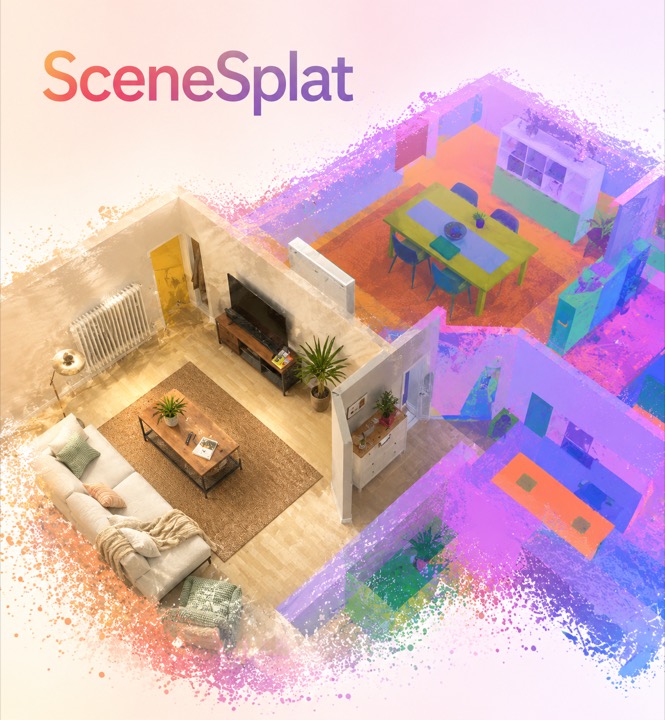 SceneSplat
Open-vocabulary 3DGS scene understanding with vision-language pretraining — ICCV 2025 Oral.
Visit project site
People


Research fellows 2


PhD students 4




Visitors 1
-
 Xiaoye Wang
Long-Term Research Visitor, 3D computer vision
Publications
44 papers since 2023, including 15 at CVPR, 6 at NeurIPS and 5 at ICCV.
Highlights
All publications 44
2026
-
P3-VLM: A Point-based Alternative for Grounded 3D Vision-Language Models
In: Conference on Neural Information Processing Systems (NeurIPS 2026)
-
GraphWrit3R: End-to-End 3D Scene Graph Writing
In: Conference on Neural Information Processing Systems (NeurIPS 2026)
-
InterEdit: Navigating Text-Guided Multi-Human 3D Motion Editing
In: European Conference on Computer Vision (ECCV 2026)
-
SPEAR-1: Scaling Beyond Robot Demonstrations via 3D Understanding
In: IEEE/CVF Conference on Computer Vision and Pattern Recognition (CVPR 2026)
-
ProOOD: Prototype-Guided Out-of-Distribution 3D Occupancy Prediction
In: IEEE/CVF Conference on Computer Vision and Pattern Recognition (CVPR 2026)
-
Inferring Compositional 4D Scenes without Ever Seeing One
In: IEEE/CVF Conference on Computer Vision and Pattern Recognition (CVPR 2026)
-
ConceptPose: Training-Free Zero-Shot Object Pose Estimation using Concept Vectors
In: IEEE/CVF Conference on Computer Vision and Pattern Recognition (CVPR 2026)
-
Chorus: Multi-Teacher Pretraining for Holistic 3D Gaussian Scene Encoding
In: IEEE/CVF Conference on Computer Vision and Pattern Recognition (CVPR 2026)
2025
-
GaussianWorld: A Large Dataset and Comprehensive Benchmark for Language Gaussian Splatting
In: Conference on Neural Information Processing Systems (Datasets and Benchmarks Track) (NeurIPS 2025)
-
Occam’s LGS: An Efficient Approach for Language Gaussian Splatting
In: British Machine Vision Conference (BMVC 2025)
-
SceneSplat: Gaussian Splatting-based Scene Understanding with Vision-Language Pretraining
In: International Conference on Computer Vision (ICCV 2025)
-
Articulate3D: Holistic Understanding of 3D Scenes as Universal Scene Description
In: International Conference on Computer Vision (ICCV 2025)
-
3D-MOOD: Lifting 2D to 3D for Monocular Open-Set Object Detection
In: International Conference on Computer Vision (ICCV 2025)
-
UniK3D: Universal Camera Monocular 3D Estimation
In: IEEE/CVF Conference on Computer Vision and Pattern Recognition (CVPR 2025)
-
Splat-SLAM: Globally Optimized RGB-only SLAM with 3D Gaussians
In: IEEE/CVF Conference on Computer Vision and Pattern Recognition Workshop (CVPRW 2025)
-
PBR-NeRF: Inverse Rendering with Physics-Based Neural Fields
In: IEEE/CVF Conference on Computer Vision and Pattern Recognition (CVPR 2025)
-
One2Any: One-Reference 6D Pose Estimation for Any Object
In: IEEE/CVF Conference on Computer Vision and Pattern Recognition (CVPR 2025)
-
In: IEEE/CVF Conference on Computer Vision and Pattern Recognition (CVPR 2025)
-
Camera-Only 3D Panoptic Scene Completion for Autonomous Driving through Differentiable Object Shapes
In: IEEE/CVF Conference on Computer Vision and Pattern Recognition Workshop (CVPRW 2025)
-
EgoGaussian: Dynamic Scene Understanding from Egocentric Video with 3D Gaussian Splatting
In: International Conference on 3D Imaging, Modeling, Processing, Visualization and Transmission (3DIMPVT 2025)
-
Mipmap-GS: Let Gaussians Deform with Scale-Specific Mipmap for Anti-Aliasing Rendering
In: International Conference on 3D Vision (3DV 2025)
-
A Large-Scale Dataset of Gaussian Splats and Their Self-Supervised Pretraining
In: International Conference on 3D Vision (3DV 2025)
-
Fine-Grained Spatial and Verbal Losses for 3D Visual Grounding
In: Winter Conference on Applications of Computer Vision (WACV 2025)
2024
-
Implicit-Zoo: A Large-Scale Dataset of Neural Implicit Functions for 2D Images and 3D Scenes
In: Conference on Neural Information Processing Systems (NeurIPS 2024)
-
Neural Vector Fields for Implicit Surface Representation and Inference
In: International Journal of Computer Vision (IJCV 2024)
-
In: Asian Conference on Computer Vision (ACCV 2024)
-
Ternary-type Opacity and Hybrid Odometry for RGB-only NeRF-SLAM
In: IEEE/RSJ International Conference on Intelligent Robots and Systems (IROS 2024)
-
Ternary-Type Opacity and Hybrid Odometry for RGB NeRF-SLAM
In: IEEE/RSJ International Conference on Intelligent Robots and Systems (IROS 2024)
-
Self-supervised Shape Completion via Involution and Implicit Correspondences
In: European Conference on Computer Vision (ECCV 2024)
-
In: European Conference on Computer Vision Workshop (ECCVW 2024)
-
Four Ways to Improve Verbo-visual Fusion for Dense 3D Visual Grounding
In: European Conference on Computer Vision (ECCV 2024)
-
Bayesian Self-Training for Semi-Supervised 3D Segmentation
In: European Conference on Computer Vision (ECCV 2024)
-
Stereo Risk: A Continuous Modeling Approach to Stereo Matching
In: International Conference on Machine Learning (ICML 2024)
-
UniDepth: Universal Monocular Metric Depth Estimation
In: IEEE/CVF Conference on Computer Vision and Pattern Recognition (CVPR 2024)
-
Rethinking Few-shot 3D Point Cloud Semantic Segmentation
In: IEEE/CVF Conference on Computer Vision and Pattern Recognition (CVPR 2024)
-
Loopy-SLAM: Dense Neural SLAM with Loop Closures
In: IEEE/CVF Conference on Computer Vision and Pattern Recognition (CVPR 2024)
-
Know Your Neighbors: Improving Single-View Reconstruction via Spatial Vision-Language Reasoning
In: IEEE/CVF Conference on Computer Vision and Pattern Recognition (CVPR 2024)
-
HandDiff: 3D Hand Pose Estimation with Diffusion on Image-Point Cloud
In: IEEE/CVF Conference on Computer Vision and Pattern Recognition (CVPR 2024)
-
Continuous Pose for Monocular Cameras in Neural Implicit Representation
In: IEEE/CVF Conference on Computer Vision and Pattern Recognition (CVPR 2024)
-
2D Feature Distillation for Weakly- and Semi-Supervised 3D Semantic Segmentation
In: Winter Conference on Applications of Computer Vision Workshop (WACVW 2024)
2023
-
LART: Neural Correspondence Learning with Latent Regularization Transformer for 3D Motion Transfer
In: Conference on Neural Information Processing Systems (NeurIPS 2023)
-
Autodecoding Latent 3D Diffusion Models
In: Conference on Neural Information Processing Systems (NeurIPS 2023)
-
Surface Normal Clustering for Implicit Representation of Manhattan Scenes
In: International Conference on Computer Vision (ICCV 2023)
-
Deformable Neural Radiance Fields using RGB and Event Cameras
In: International Conference on Computer Vision (ICCV 2023)
No papers match.
Partners

More topics
Vision Lab works on 6 topics. See them all on the Vision Lab page.
5 more topics
-
 Robotics
 foundation models for physical AI—VLAs, dexterous manipulation, and learning from human and robot experience.
-
 Space AI
Reliable Understanding and Reasoning for Earth Observation
-
 Egocentric Vision
Intelligence from the First-Person Perspective
-
 Visual Media
Processing, Editing, and Generating the Visual World
-
 Vision Agent
From Multimodal Foundation Models to Executable Visual Intelligence