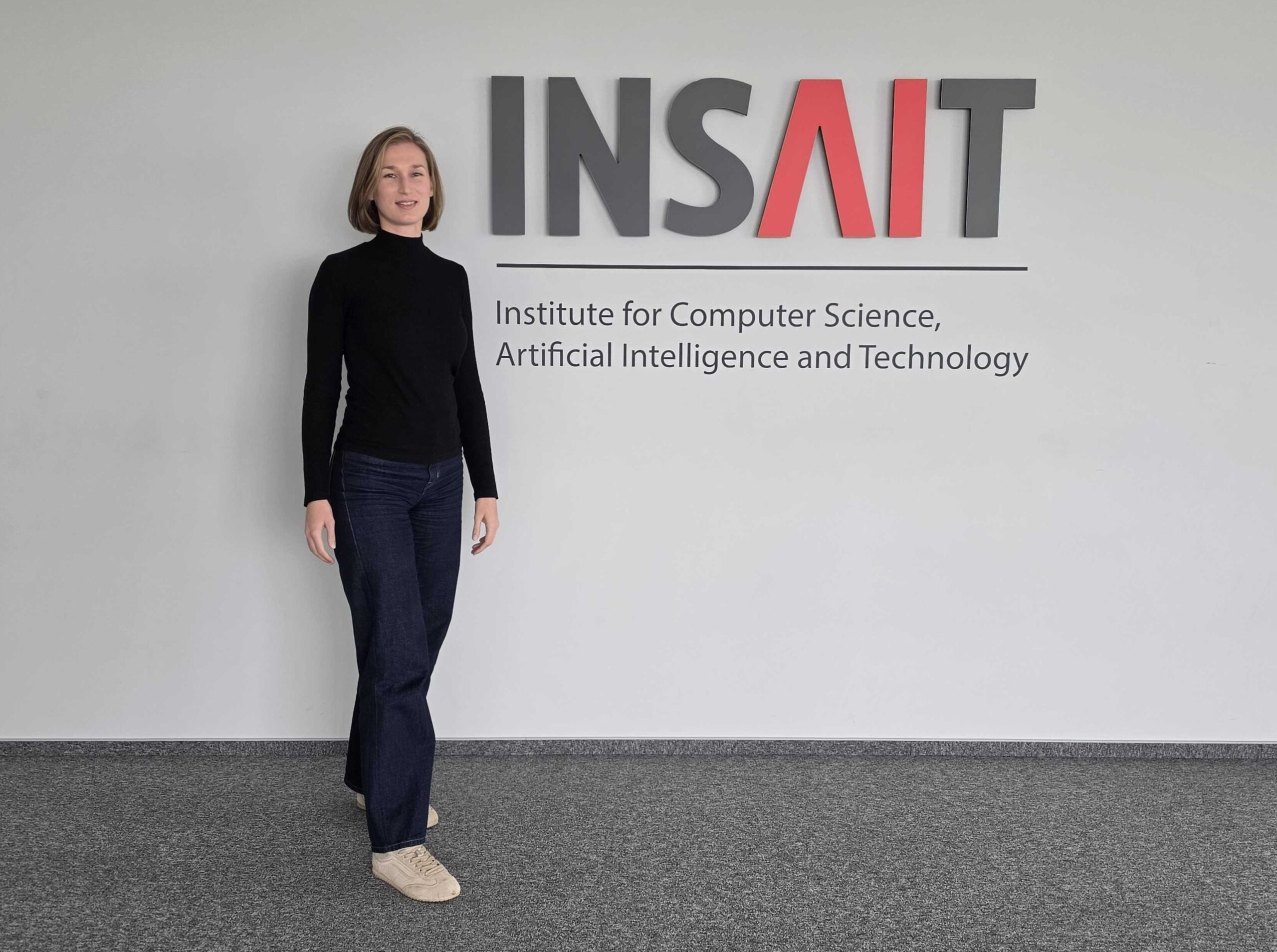
Following a career in the US and Canada, Dr. Aleksandrina Goeva returns to Bulgaria to lead research that could reshape the future of medicine
Artificial intelligence that reveals how diseases change human cells and helps discover new drugs and treatments. This is the ambition behind an entirely new research direction being launched at Bulgaria’s INSAIT, part of Sofia University “St. Kliment Ohridski.”
The new direction will be led by Dr. Aleksandrina Goeva, an internationally recognized Bulgarian scientist with an impressive career in the US and Canada. She returns to Bulgaria from the University of Toronto, where she founded and led her own research group in machine learning and computational biology. Previously, she spent seven years at the prestigious Broad Institute of MIT and Harvard.
INSAIT offers her the opportunity to continue conducting world-class research while contributing her knowledge and experience to the advancement of Bulgarian science and the development of technologies that could reshape the future of medicine. The institute’s new direction will bring together advances in artificial intelligence, mathematics, and biology to address one of the most important questions in modern medicine: how to detect disease-related changes earlier and steer cells back toward healthy function.
At the heart of this research is AI’s ability to analyze vast amounts of biological data and uncover patterns that remain undetected by traditional methods. This will allow researchers to predict how cells respond to different drugs and identify which compounds or combinations hold the greatest therapeutic potential. This is especially important because the possible combinations are virtually countless, while laboratory experiments can explore only a small fraction of them.
Aleksandrina Goeva’s scientific career began in Bulgaria. She is a graduate of the Sofia High School of Mathematics and studied Applied Mathematics at Sofia University. She continued her education in the US, earning a master’s degree in Mathematics and a Ph.D. in Statistics from Boston University. Her research has been published in some of the world’s most prestigious scientific journals, including Science, Cell, Nature Biotechnology, Nature Communications, and Cell Reports. Her work has received more than 7,200 citations, according to Google Scholar, a reflection of its international recognition and significance. She is also the creator of HiDDEN, an innovative machine learning method that uncovered previously overlooked cellular changes associated with the development of blood cancer and dysfunction of the brain’s protective barrier. Her discoveries open new possibilities for earlier diagnosis and a better understanding of serious diseases.