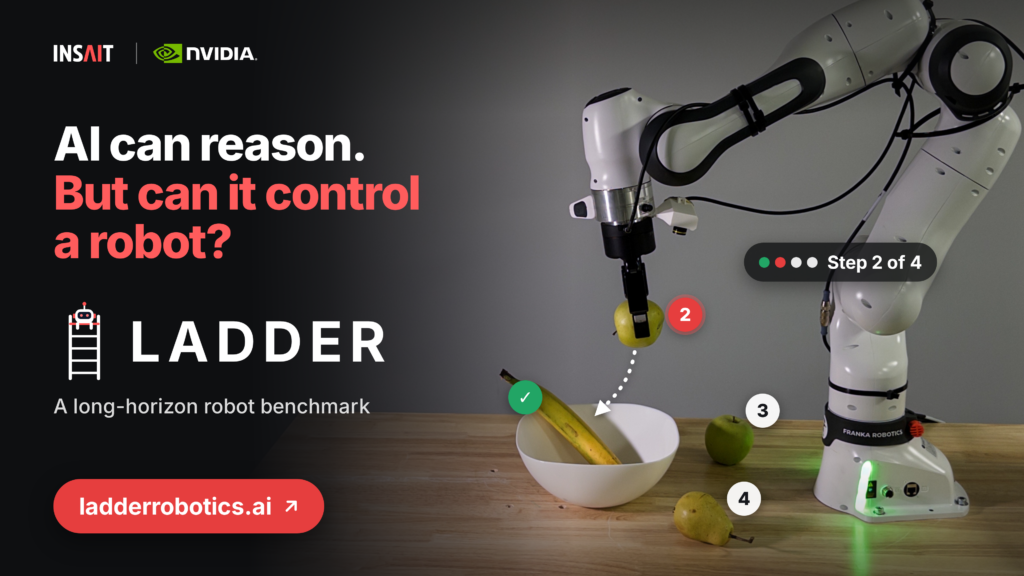
AI can solve the hardest math problems and make humanoids do backflips. But can it control a robot to clean up a messy table?
Robot manipulation remains a major challenge for Physical AI. Even the best AI models struggle with everyday tasks. Moving one item is easy. Moving ten, one by one, is a different story!
Today, INSAIT and Nvidia are launching LADDER, a frontier public robotics benchmark for testing AI models on everyday multi-step manipulation tasks, both on real robots and in simulation.
Frontier AI models are the best, but still far from reliable: GPT-6 Astra, Claude Opus 5.5, and Gemini 4 Argon top the leaderboard, but still fail on many tasks, especially the ones with more steps.
Specialized robotics models are even worse: π0.5, a leading model built specifically for robotics, can move a single object, but almost never manages to move five or more objects in a row.
Even successful attempts are very expensive: With GPT-6 Astra, each successful attempt costs over $6 on average and evaluating the model on the full ~2000 attempts in the benchmark costs around $8,000.
LADDER will be updated as new models are released, tracking the state of the art in robot manipulation.
Explore the live leaderboard, robot videos, and full study at ladderrobotics.ai.